
“How often do you think about the Roman Empire?”
A lot. Probably too much.
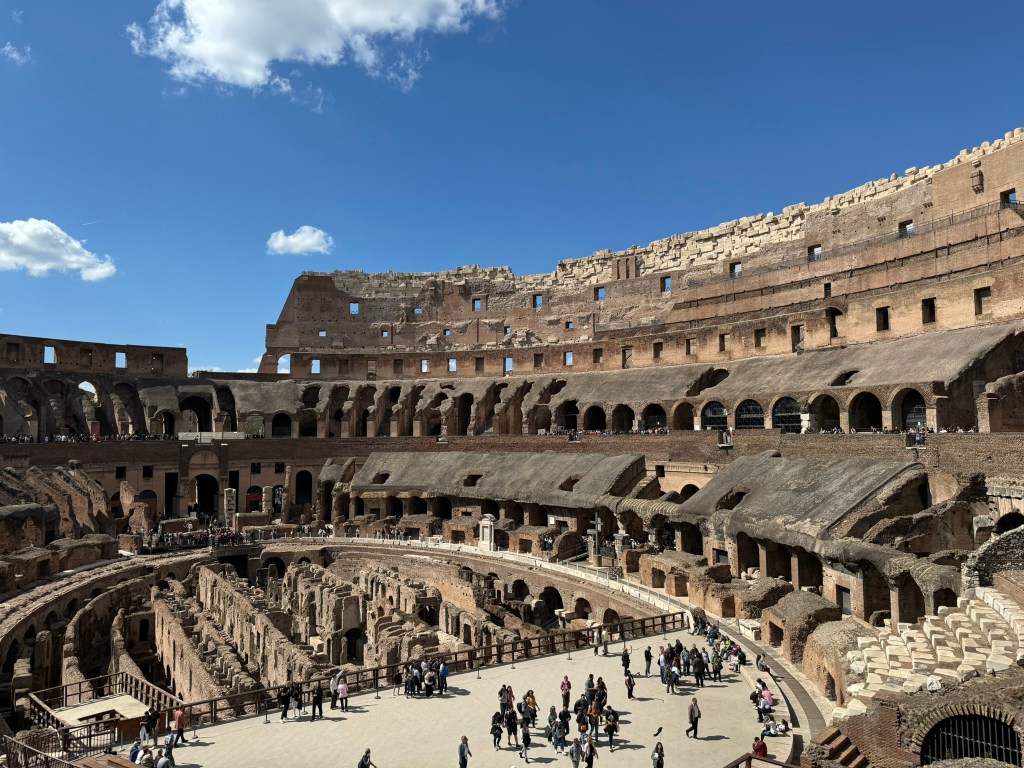
My son and I were talking about this recently — corruption, concentration of power, impunity, what happens when a political system gets captured by its wealthiest participants. I started sharing some of the parallels I’d been seeing between Rome and the United States. The wealth concentration. The currency debasement. The manufactured xenophobia. The impunity. We ran out of time before I could finish.
So I wrote it down. For him. And for anyone else willing to sit with the comparison.
I don’t think most people understand how wealthy Rome actually was — and more importantly, what happened when that wealth concentrated into fewer and fewer hands. How the elite learned to manipulate the populace in ways that feel disturbingly familiar. How their power became untouchable. And how, once it did, the ruling class became increasingly predatory — in ways that are shockingly, specifically familiar.
What follows is a factual historical essay about how a republic destroys itself. Every claim is sourced. The history is settled. You can decide for yourself where we stand on this continuum. I’m not writing this because it’s hopeless. It’s never hopeless.
I. The Concentration
The Roman Republic was, for a meaningful stretch, a functional system of distributed governance. Deeply flawed. But designed around a principle that should sound familiar to anyone who’s studied systems architecture: no single node accumulates enough power to override the network.
That design failed. And it failed for the most predictable reason imaginable: money.
After Rome defeated Carthage in 146 BC, the spoils of imperial conquest began flowing to a narrow elite. Senatorial families accumulated fortunes that would have been incomprehensible a generation earlier. Scipio Africanus awarded himself 700,000 denarii after his victory — at a time when a Roman soldier earned 10 denarii a month.[1] Within a century, Crassus controlled a fortune nearly forty times that size.[1]
The mechanism was straightforward. Wealthy Romans bought agricultural land at scale, displacing the small citizen-farmers who’d been the republic’s economic backbone. Historian Mike Duncan describes the process bluntly: “In the 130s and 140s you have this process of dispossession, where the poorer Romans are being bought out and are no longer small citizen owners. They’re going to be tenant owners or sharecroppers, and it has a really corrosive effect on the traditional ways of economic life and political life.”[2]
I grew up on a little farm south of San Jose. I watched what happened to that land and through the valleys to the South— not over centuries, but over a childhood. Orchards became subdivisions. Family farm operations became corporate holdings.
The modern version of this displacement doesn’t require a conquering army. It requires a fund. In Q1 2025, investors purchased 27% of all U.S. homes sold. By Q2, that share hit a record 33%.[43] MetLife Investment Management projects institutional investors may control 40% of U.S. single-family rental homes by 2030.[43] The pattern extends to farmland: over 300 private equity funds now target agriculture specifically, with institutional investors collectively holding between 170,000 and 300,000 single-family farms by mid-decade, according to a U.S. Government Accountability Office study.[44] Private equity firms bulk-purchase foreclosed homes at auction, acquire farms from aging owners who can’t compete on price, and convert owner-occupied properties into rentals — the modern latifundia.
The citizen-farmer who was Rome’s economic backbone has an American equivalent: the family that could once build generational wealth through homeownership. Both are being displaced by the same force. Concentrated capital, deployed at scale, buying the foundation out from under the people who stand on it.
The wealth gap didn’t just widen. It calcified. Political office required personal wealth. Campaigns demanded ever-larger expenditure. Gladiatorial shows — the currency of public influence — escalated from 25 pairs of fighters in 200 BC to 120 pairs by 183 BC.[1] The price of entry to public life rose until only the already-wealthy could participate. Money bought office. Office protected money.
Economists Walter Scheidel and Steven Friesen reconstructed Roman inequality using papyri ledgers and scholarly estimates. They calculated a Gini coefficient of 0.42–0.44 for the Roman Empire.[3] The Gini coefficient measures inequality on a scale from 0 to 1 — where 0 means every person holds equal wealth and 1 means a single person holds everything. At 0.43, Rome had reached a level of concentration that historians now recognize as structurally destabilizing.
The United States’ Gini coefficient in 2007 was 0.45. More unequal than Rome.[3]
As of Q2 2025, the top 1% of American households hold approximately 31% of total national wealth. The bottom 50% — roughly 66 million households — hold 2.5%.[4] Three individual Americans possess more wealth than that entire bottom half combined.[4] The top 1%’s share has grown from 23% to 31% since 1989, while the bottom 50%’s share has declined by 26%.[5]
Rome’s senatorial class needed a minimum of 1 million sesterces to qualify for office. America’s equivalent barrier is less formal but no less real: the average cost of winning a U.S. Senate seat now exceeds $10 million. The mechanism is identical. Wealth purchases access to governance. Governance protects the accumulation of wealth.

Rome tried to fix this. It passed at least six major anti-bribery laws (leges de ambitu) over two centuries. The Lex Baebia (181 BC) banned electoral bribery outright. The Lex Acilia Calpurnia (67 BC) imposed permanent disqualification from office. Cicero’s Lex Tullia (63 BC) added ten years’ exile and banned candidates from hosting public spectacles within two years of an election.[21] Every law more severe than the last. Every law failed. The Global Anticorruption Blog’s analysis concludes that these reforms “ended up being not only ineffective, but actively exacerbated the decline of the Republic” — because those with the most money used the laws themselves as weapons against political rivals while continuing to buy elections unchecked.[22]
The United States took the opposite approach. Rather than passing increasingly strict anti-corruption laws that the powerful circumvented, America dismantled its existing ones.
In 2010, the Supreme Court’s Citizens United v. FEC decision struck down century-old restrictions on corporate election spending. The ruling held that limiting independent political expenditures by corporations violated the First Amendment. In dissent, Justice Stevens cited polling showing 80% of Americans viewed corporate independent expenditures as a mechanism for gaining “unfair legislative influence.”[23] The effect was immediate. From 2010 to 2022, super PACs spent $6.4 billion on federal elections. In 2024 alone, they spent a record $2.7 billion.[24] Billionaire election spending increased over 160-fold, and the top 1% of donors provided 96% of all super PAC funds.[25]
The concentration became extreme. In the 2016 presidential race, half of all campaign funding came from just 16,000 donors out of 3.2 million total contributions.[26] By 2024, a single billionaire contributed over $290 million to outside spending groups — roughly equivalent to the combined donations of 3 million small donors.[25] Former President Jimmy Carter called the result “an oligarchy with unlimited political bribery.”[23]
Rome’s approach and America’s approach look like opposites — one tightened laws, the other loosened them. They produced the same outcome: a political system in which wealth was the primary determinant of political power, and in which the mechanisms designed to prevent that capture were either weaponized or eliminated by the very class they were meant to constrain.
II. The Debasement
Wealth concentration creates a fiscal problem that no republic has ever solved cleanly. The more wealth flows to the top, the less revenue the state collects. The less revenue the state collects, the more it borrows — or the more it debases its currency to cover the gap.
Rome discovered this. America is rediscovering it now.
When the denarius was introduced around 211 BC, it contained roughly 4.5 grams of nearly pure silver — about 95% fineness.[27] For almost three centuries, it held. Augustus restored it to 98% purity after the civil wars. The denarius was the reserve currency of the ancient world, accepted from Britain to Mesopotamia, its value rooted in the fact that it contained what it claimed to contain.[28]
Then the bills came due.

Nero, facing the cost of rebuilding Rome after the Great Fire of 64 AD and funding wars on multiple fronts, cut the denarius to roughly 90% silver and reduced its weight. The coin looked the same. It spent the same. But it’s worth less.[28] This set a precedent that proved, in the words of one monetary historian, “very hard to stop.” Trajan tried to restore public confidence by minting coins with old Republican designs, an appeal to tradition and stability. He debased the denarius by another 3–4% within six months.[29] Marcus Aurelius dropped it to 75%. Septimius Severus to 50%. His son Caracalla introduced the antoninianus — nominally worth two denarii but containing only 1.5 times the silver.[28] By the reign of Claudius II in 269 AD, Roman silver coins contained 2% silver.[30]
The currency that had underpinned the world’s largest economy for half a millennium was bronze with a silver wash.
The consequences were predictable. The state itself stopped trusting its own money. The Roman administration began insisting that taxes and duties be paid in gold or in kind — refusing the very currency it’s printing.[29] Prices spiraled. Cities that depended on functioning currency for commerce degenerated. Constantine eventually stabilized the monetary system with the gold solidus, but the damage to silver-based commerce was permanent. Where one denarius could buy a craftsman’s daily wages in 85 AD, by the late empire, a single gold solidus was worth millions of denarii.[31]
The United States has followed a strikingly similar trajectory — compressed into a shorter timeframe and mediated through different instruments, but structurally identical.
The dollar has lost over 96% of its purchasing power since the creation of the Federal Reserve in 1913.[32] That year, $1 bought 30 Hershey’s chocolate bars. Today it buys a cup of coffee.[33] The erosion accelerated dramatically after 1971, when Nixon ended the dollar’s convertibility to gold — the American equivalent of Nero’s first cut. The constraint that had prevented unlimited money creation was removed. Money creation accelerated accordingly.
The fiscal numbers are now Roman in scale. As of September 2025, federal debt stands at $37.6 trillion — up $2.2 trillion in a single fiscal year.[34] Interest on that debt reached $1.2 trillion in FY2025, nearly doubling in three years and now exceeding the defense budget.[34] The annual deficit of $1.8 trillion represents 5.9% of GDP — more than 1.5 times the 50-year historical average, and a level exceeded only during wartime or severe recession.[35] Debt held by the public has reached 99.8% of GDP, roughly double the 50-year average of 51%.[36]
The Congressional Budget Office projects deficits exceeding $2 trillion annually for the next decade, with debt climbing to 120% of GDP by 2035.[37] Interest payments alone are projected to nearly double again, reaching $1.8 trillion by 2035.[37] The Committee for a Responsible Federal Budget puts it plainly: “The federal government remains on an unsustainable long-term fiscal path.”[34]
Rome debased its currency because it had no bond market — no mechanism for deficit financing other than reducing the metal content of its coins.[28] America has a bond market, which means it can borrow instead of visibly debasing. The effect is the same: the gap between what the government spends and what it collects is covered by creating obligations that dilute the value of existing currency. Rome’s method was cruder. America’s is more sophisticated. The endpoint — a currency that no longer holds the trust of the people who use it — is identical.
Nero made the first cut in 64 AD. It took two centuries to reach 2% silver. The Fed was created in 1913. The dollar has lost 96% of its purchasing power in 112 years.
The American debasement is happening faster.
III. The Distraction
A republic this unequal should collapse under the weight of its own contradictions. Rome’s elite solved this problem with a strategy so effective it has been replicated in every declining republic since.
They manufactured enemies.

Rome’s relationship with foreigners was complex. The republic had, for centuries, absorbed immigrant populations — integrating them into the military, the economy, and eventually the citizenry. Ammianus Marcellinus documented how Rome was “dependent on the help of these same foreigners for their livelihood.”[6] Machiavelli, studying Livy centuries later, praised Rome’s openness to foreigners as integral to its military and economic power.[7]
But as internal inequality generated internal discontent, the elite redirected that anger outward. Foreigners — many displaced by Rome’s own military campaigns — were recast as existential threats. The poet Claudian captured the mood with disturbing casualness: “Everyone insults the immigrant.”[8]
The xenophobia was strategic. Ammianus connected the rise of anti-foreigner sentiment to what he called “the crisis of the Roman value system” — a crisis generated not by immigration but by the corruption and extraction of the ruling class.[9] Immigrants’ houses of worship were set on fire. Families beaten on roads. Doors slammed in the faces of people asking for food.[8]
The pattern is unmistakable. The Roman elite created a framework in which poor citizens and immigrants — natural economic allies — were set against each other while the senatorial class continued consolidating wealth and power undisturbed.
The data on immigration in America tells a story that directly contradicts the political narrative. Immigrants are 60% less likely to be incarcerated than native-born citizens, according to a 150-year analysis of Census data published by the National Bureau of Economic Research.[10] Undocumented immigrants in Texas are arrested at less than half the rate of native-born citizens for violent crimes, per NIJ-funded research.[11] The American Immigration Council found that as the immigrant share of the U.S. population more than doubled between 1980 and 2022, the total crime rate dropped by 60.4%.[12]
The data is unambiguous. The rhetoric is manufactured. The function — in Rome and in America — is identical: redirect the rage of the economically dispossessed away from the class responsible for their dispossession.
But rhetoric is only half the pattern. Rome didn’t just talk about immigrants as threats. It organized violence against them. In 2025, America crossed that line.
In the first year of the second Trump administration, the United States launched what it explicitly described as “the largest domestic deportation operation” in the nation’s history. ICE detention rose nearly 75%, from 40,000 people in January 2025 to 66,000 by December — the highest level ever recorded.[38] Facilities used for immigration detention increased by 91% in a single year.[38] Congress authorized $170 billion in immigration enforcement spending, including $45 billion explicitly for expanding detention capacity.[39] ICE hired 12,000 new agents, with training compressed from five months to 47 days.[40]
The enforcement was not targeted at public safety threats. Arrests of people with no criminal record surged by 2,450%.[38] The administration deployed roving patrols, worksite raids, and began arresting immigrants at their own court hearings and scheduled check-ins — punishing people for complying with the legal system.[39] A federal judge ruled the roving patrols illegal for violating standards of reasonable suspicion.[41] The administration continued them.
More people died in ICE detention in 2025 than in the previous four years combined — 32 deaths compared to 24 during the entire Biden presidency.[41] Amnesty International documented arbitrary detention, overcrowding, 24-hour lighting, medical negligence, retaliatory solitary confinement, and violence by guards — including in the presence of human rights monitors.[41] On a military base repurposed as a detention center in Montana, a Cuban man died in custody. ICE called it suicide. The medical examiner ruled it homicide.[41]
The administration detained U.S. citizens. ProPublica confirmed at least 170 citizen detentions by October 2025.[40] ICE confirmed in court records that it was detaining people without first validating citizenship status.[41] Citizens were grabbed at Walmart parking lots, pulled from cruise ship cabins, zip-tied on their way home from work. A disabled adult. Children. Elected officials. Puerto Rican and Indigenous Americans stopped because they looked like they might be foreign.[41]
Members of Congress were prohibited from conducting lawful inspections of detention facilities. Three immigration oversight sub-agencies were effectively eliminated.[38] The administration gutted internal watchdog offices while expanding enforcement authority to state and local police through 1,300 new 287(g) agreements — up from 135 the year before.[42]
Ammianus described Rome’s anti-immigrant violence as symptomatic of a “crisis of the Roman value system” — a crisis caused not by foreigners but by the corruption of the ruling class.[9] Claudian noted that “everyone insults the immigrant” even as Rome’s economy depended on immigrant labor.[8] The violence was strategic displacement: redirect internal anger at the visible other while the invisible extraction continues undisturbed.
The American version is more organized, better funded, and proceeding at industrial scale. The immigrants are 60% less likely to commit crimes than the citizens detaining them.[10] The $170 billion enforcement budget exceeds what most countries spend on their entire military. The infrastructure — tent camps, repurposed military bases, a revived Guantanamo Bay as a deportation staging ground — is being built while the national debt climbs $68,902 every second.[34]
The distraction is expensive. It’s meant to be. The expense is the point — it creates jobs, contracts, and political constituencies invested in perpetuating the manufactured threat. Rome’s gladiatorial industry worked the same way.
IV. The Abomination
The darkest chapter of Rome’s decline involves the exploitation of children by its most powerful men.
This is not speculation. It’s documented in primary sources, most extensively in Suetonius’ Lives of the Caesars, written in the early second century AD with access to imperial archives, personal correspondence, and court documents.[13]
The Roman elite’s sexual exploitation of children was endemic and institutionalized. The system operated on a legal framework in which enslaved children had no bodily autonomy whatsoever. As historian Ulrike Roth writes: “Sexual interactions between free adult men and enslaved pubescent boys are repeatedly reported in the surviving sources as forced upon the youngsters, with a focus on youths up to 14 years of age.”[14] The overlap between children’s service roles — serving at banquets, attending to domestic needs — and their sexual exploitation was, in Roth’s words, “powerfully brought out in full-size sculptures displayed in many elite Roman homes.”[14]
Emperor Tiberius represents the most documented case. After retreating to his private villa on the island of Capri in 26 AD — far from public scrutiny — Suetonius records that he “trained little boys (whom he termed tiddlers) to crawl between his thighs when he went swimming and tease him with their licks and nibbles.”[15] The villa itself was furnished with pornographic art and equipped with children dressed as mythological figures for sexual purposes.[16] Scholar Bill Gladhill’s analysis in Eugesta describes how “children are pervasive” in Suetonius’ account of Capri — transformed into “spintriae and pisciculi,” dehumanized, their developmental stages “obliterated.”[16]
When brothers whom Tiberius had abused reproached each other for their degradation, the emperor had their legs broken.[15]
The reliability of Suetonius is debated — Tacitus, considered more reliable, alludes to Tiberius’ vices without detailing them.[13] But the broader system of child exploitation in Rome is not in dispute. It was legal. It was widespread. It was practiced overwhelmingly by the powerful against the powerless. Roman law explicitly permitted the sexual use of enslaved minors. The scholar Christian Laes notes that “Roman sexual criteria were based on physical development and status, rather than a definitive age.”[17]
Now hold that history — the private island, the powerful man beyond accountability, the exploitation of children, the legal system that looked the other way — and consider what has emerged about America’s wealthy elite.
Jeffrey Epstein is the most documented case, but the pattern is the point. A financier with ties to presidents, princes, tech billionaires, and hedge fund managers operated a child sex trafficking network for decades. The question was never whether powerful men participated. The question was whether any system — legal, political, journalistic — would hold them accountable.
In 2005, the parents of a 14-year-old girl reported that she had been molested at a millionaire’s home in Palm Beach, Florida. Police identified at least 35 girls with similar stories: Epstein was paying high school-age students $200 to $300 for sexualized encounters.[18] Federal prosecutors drafted indictments. Then Miami U.S. Attorney Alexander Acosta struck a plea deal that let Epstein plead to state charges of soliciting prostitution from a minor. He served 13 months in a county jail with work-release privileges.[18]
Acosta was later appointed U.S. Secretary of Labor.[19] The prosecutor who protected a child sex offender was rewarded with a cabinet position overseeing, among other things, human trafficking policy. In Rome, Tiberius retreated to Capri because he could. In America, the system didn’t just look away — it promoted the people who facilitated the looking away.
After the Miami Herald exposed the plea deal in 2018, Epstein was arrested again in July 2019. One month later, he was found dead in his federal detention cell. Guards were absent. Surveillance systems malfunctioned.[18]
On February 21, 2025, Attorney General Pam Bondi told Fox News that Epstein’s “client list” was “sitting on my desk right now.”[20] FBI agents had written to superiors that no such client list existed.[20] The Epstein Files Transparency Act, signed in November 2025, compelled the release of over 3 million pages of documents.[19] The released files named powerful men across politics, finance, academia, and royalty.[19]
As of today, the AP reports that the FBI has concluded its investigation. Four or five accusers claimed other men had sexually abused them. The FBI found “not enough evidence to federally charge these individuals.”[20] No videos showed victims being abused. No financial records connected payments to criminal activity. The cases were referred to local law enforcement.[20]
Ghislaine Maxwell is serving 20 years. She is the only person other than Epstein to face criminal consequences.[18] Three million pages of documents. Names across politics, finance, academia, and royalty. Zero additional prosecutions.
And then there is the sitting President of the United States.
Donald Trump maintained a close friendship with Jeffrey Epstein for roughly fifteen years. They socialized at parties in Palm Beach, attended Victoria’s Secret events together in New York, and traveled between properties on Epstein’s private jet.[49] In 2002, Trump told New York Magazine that Epstein was a “terrific guy” and that “he likes beautiful women as much as I do, and many of them are on the younger side.”[49] Trump owned the Miss Teen USA pageant from 1996 to 2015. Four contestants from the 1997 competition told BuzzFeed that Trump walked into their dressing room while they were changing. Trump himself told Howard Stern in 2005 that he could “get away with” going backstage at pageants while contestants were undressing.[50] At least 28 women have accused Trump of sexual misconduct since the 1970s, including rape, groping without consent, and walking in on naked teenage pageant contestants.[50]
Virginia Giuffre — one of Epstein’s most prominent accusers, who died by suicide in April 2025 — was recruited into Epstein’s sex trafficking operation while working as a teenage locker-room attendant at Trump’s Mar-a-Lago club.[49] Trump has claimed he banned Epstein from Mar-a-Lago in the mid-2000s for “being a creep.” But when Rep. Jamie Raskin reviewed the unredacted Epstein files at DOJ headquarters in February 2026, he found a 2009 email exchange between Epstein and Ghislaine Maxwell in which Trump is paraphrased as saying: “No, Jeffrey Epstein was not a member of Mar-a-Lago, but he was a guest at Mar-a-Lago, and no, we never asked him to leave.”[51] Raskin reported that Trump’s name appears in the unredacted files “more than a million times” — compared to roughly 38,000 mentions in the redacted public release, which would mean the DOJ redacted more than 96% of the references.[51]
The files released in January 2026 included an FBI compilation of more than a dozen sexual assault allegations related to Trump, many submitted through the FBI’s tip line.[52] Among them: an allegation that Epstein introduced a 13-to-15-year-old girl to Trump, who subsequently forced her head toward his exposed penis — an account that matches a civil lawsuit filed and later dropped in 2016.[52][50] Another victim told investigators that Maxwell “presented” her to Trump at a New York party and made clear she was “available.”[52] An FBI summary slide listed the allegations under “Prominent Names.”[52] The DOJ preemptively labeled these claims “unfounded and false” in its press release accompanying the files — an extraordinary editorial intervention for a department that typically lets evidence speak for itself.[53]
Trump fought hard to prevent Congress from passing the Epstein Files Transparency Act, personally lobbying Republican members at the White House before being outmaneuvered by bipartisan support.[54] His administration initially refused to release files, then released them with extensive redactions — including blacking out Trump’s face on a news article sent by advisor Steve Bannon, and briefly removing a spreadsheet containing allegations against Trump before restoring it after public outcry.[53] Rep. Ro Khanna, who co-authored the transparency law with Republican Thomas Massie, said the DOJ has not released a single one of the FBI’s victim interview memoranda — the documents in which survivors named specific men to whom they were trafficked.[54]
If a person talks constantly about a particular activity, socializes extensively with people who engage in that activity, maintains a decades-long close friendship with the most prolific known practitioner of that activity, operates a contest that could serve as a direct recruiting pipeline for that activity, appears in the documentary record of that activity tens of thousands of times, has more than two dozen independent accusers alleging adjacent versions of that activity, and then uses the power of the presidency to obstruct the release of evidence. At some point, the inference isn’t inference anymore.
No criminal charges have been filed against Trump in connection with Epstein’s crimes. That is a fact. It’s also a fact that no criminal charges were filed against any of the powerful men named in three million pages of evidence. The absence of charges, in a system where the people under investigation control the investigative apparatus, is not exculpatory. It’s the system working as designed.
Tiberius had an island. Epstein had an island. The Roman Senate averted its eyes. The FBI closed its investigation. The consistency across two thousand years isn’t a coincidence. It’s the predictable behavior of a class that has accumulated enough wealth and political power to place itself beyond the reach of the legal systems that govern everyone else.
V. The Mirror
I laid out these dynamics — wealth consolidation, displacement of citizen-owners, currency debasement, manufactured xenophobia, elite child exploitation with institutional impunity — as parallel histories of Rome and the United States because that’s what they are. Parallel. Not metaphorical.
Rome’s Gini coefficient was 0.43. America’s is 0.45.[3]
Rome’s senatorial class bought up farmland at scale, displacing citizen-farmers and converting them into tenants. American investors now purchase one in three homes sold, and institutional funds target hundreds of thousands of farms.[43][44]
Rome debased its currency from 95% silver to 2% over four centuries. America’s dollar has lost 96% of its purchasing power in one.[32]
Rome manufactured fear of “barbarians” to distract from oligarchic extraction. America manufactures fear of immigrants who commit crimes at less than half the rate of native-born citizens — then spends $170 billion to detain them while the national debt grows by $5 billion a day.[10][11][39][34]
Rome’s most powerful men sexually exploited children on private islands while the legal system enabled or ignored the abuse. America’s wealthiest class socialized with — and in some cases participated in the network of — a convicted child sex offender who operated from private islands, and the legal system produced exactly one additional conviction out of 3 million pages of evidence.[18]
When we study Rome’s decline, we feel moral clarity. We look at Tiberius on Capri and feel revulsion. We look at the manufactured xenophobia and see it for what it was — a tool of the ruling class. We look at the wealth concentration and recognize it as the engine of collapse.
Revulsion. Clarity. Moral certainty. We’re confident we would have seen it clearly if we’d been there. We are there.
Historian Edward Watts, whose Mortal Republic chronicles Rome’s fall into tyranny, was asked whether the U.S. is following Rome’s trajectory. His answer: “If you start to do some comparisons between the rise and development of the U.S. and rise and development of Rome, you do wind up in this same place.”[2]
The question that matters isn’t whether future historians will draw these parallels. They will. The question is whether we do anything while we’re still inside the history being written.
VI. The One Thing
Every dynamic in this essay — the wealth concentration, the debasement, the manufactured xenophobia, the impunity — traces back to a single structural failure: the conversion of money into political power without limit or transparency.
Rome tried to fix it six times. Every law failed because the wealthy weaponized the reforms against rivals while continuing to buy elections unchecked. America took the opposite approach — dismantled its reforms — and arrived at the same endpoint. Different methods. Same capture.
Think about it this way. A senator who needs $10 million to run for office doesn’t call the people who voted for them. They call the people who can write a check. And the person who writes the check doesn’t need to ask for a favor — the dependency is the favor. That’s the structural failure. The concentration, the debasement, the xenophobia, the impunity — every dynamic in this essay tracks back to the source of the money.
So here’s where I land. The single highest-leverage action available to any citizen reading this is to support the legal effort to restore limits on money in politics. There is one active case that could do exactly that.
In November 2024, Maine voters passed Question 1 with 75% approval — one of the most bipartisan ballot results in the country — capping contributions to super PACs at $5,000.[45] A federal judge blocked the law in July 2025. The case, Dinner Table Action v. Schneider, is now before the First Circuit Court of Appeals — the only federal circuit that hasn’t yet ruled on whether super PACs are constitutionally required.[46]
If the First Circuit upholds Maine’s law, the case goes to the Supreme Court. Harvard Law professor Lawrence Lessig, who designed the legal strategy, isn’t asking the Court to overturn Citizens United. He’s arguing that Citizens United itself — correctly read — already permits states to limit contributions to super PACs, and that the 2010 D.C. Circuit decision in SpeechNow v. FEC that created super PACs was wrongly decided.[47] Reply briefs were filed January 30, 2026. A ruling could come this spring, with the Supreme Court potentially hearing the case by fall 2026.[46]
This isn’t theoretical. It’s in motion. And 79% of Americans already agree that Citizens United should be overturned.[47]
You can support Equal Citizens at equalcitizens.us. Follow the case. Share it. Donate. Contact your state legislators and ask them to pass similar ballot initiatives — Montana has one on the ballot for 2026.[48]
Rome never fixed the money problem. It passed law after law, and the wealthy captured every single one. The Republic fell. That outcome wasn’t inevitable. It was the result of a political class that chose not to act while action was still possible — and a citizenry that let them.
We still have the choice.
References
[1] Edward Watts, Mortal Republic: How Rome Fell into Tyranny (Basic Books, 2018), via The Metasophist, “How Inequality Killed the Roman Republic,” January 2021.
[2] Mike Duncan, interview with Smithsonian Magazine, “Before the Fall of the Roman Republic, Income Inequality and Xenophobia Threatened Its Foundations,” November 2017.
[3] Walter Scheidel and Steven Friesen, “The Size of the Economy and the Distribution of Income in the Roman Empire,” Journal of Roman Studies 99 (2009), via Per Square Mile, “Income Inequality in the Roman Empire,” December 2011.
[4] Federal Reserve Distributional Financial Accounts, Q2 2025. Top 1% held approximately 31% of household net worth. Institute for Policy Studies analysis of Federal Reserve data, September 2025.
[5] Institute for Policy Studies, “Billionaire Wealth Concentration Is Even Worse than You Imagine,” September 2025, analyzing Federal Reserve DFA data 1989-2024.
[6] Ammianus Marcellinus, Res Gestae, via TIME, “Ancient Rome Thrived When the Empire Welcomed Immigrants,” June 2020.
[7] Niccolò Machiavelli, Discourses on Livy, Book II, Chapter 3.
[8] Claudian, quoted in Douglas Boin, via TIME, “Ancient Rome Thrived When the Empire Welcomed Immigrants,” June 2020.
[9] Vladimir Dmitriev, “Strangers in Rome: The Attitude of the Romans Towards Immigrants in Late Antiquity (According to Ammianus Marcellinus),” SSRN, February 2021.
[10] Ran Abramitzky, Leah Boustan, Elisa Jácome, Santiago Pérez, “Law-Abiding Immigrants: The Incarceration Gap Between Immigrants and the US-Born, 1870-2020,” American Economic Review: Insights, December 2024.
[11] Michael T. Light, “Unauthorized Immigration, Crime, and Recidivism: Evidence from Texas,” National Institute of Justice, January 2024 (NIJ Award No. 2019-R2-CX-0058).
[12] American Immigration Council, “Debunking the Myth of Immigrants and Crime,” October 2024, analyzing demographics and crime data 1980-2022.
[13] “Did Emperor Tiberius Abuse Young Children on Capri?” Bad Ancient, analyzing Suetonius, Life of Tiberius 44.1, and Tacitus, Annals 6.51.
[14] Ulrike Roth, “Confronting Gender-based Violence in Ancient Rome: The Sexual Violation of Pubescent Boys,” 16 Days Blogathon, November 2021.
[15] Suetonius, Life of Tiberius, Sections 43-45, trans. J.C. Rolfe, via Livius.org.
[16] Bill Gladhill, “Tiberius on Capri and the Limits of Roman Sex Culture,” Eugesta 12 (2022).
[17] Christian Laes, Children in the Roman Empire: Outsiders Within (Cambridge University Press, 2011), reviewed in Bryn Mawr Classical Review, 2011.10.46.
[18] Associated Press, “Takeaways From What the Epstein Files Show About the FBI Investigation of Possible Sex Trafficking,” February 8, 2026.
[19] PBS NewsHour, “A Timeline of the Jeffrey Epstein Investigation and the Fight to Make the Government’s Files Public,” February 6, 2026.
[20] U.S. News & World Report / AP, “FBI Concluded Jeffrey Epstein Wasn’t Running a Sex Trafficking Ring for Powerful Men, Files Show,” February 8, 2026.
[21] Wikipedia, “Ambitus,” citing Lex Cornelia Baebia (181 BC), Lex Acilia Calpurnia (67 BC), and Lex Tullia (63 BC); Suetonius and Cicero primary sources.
[22] Global Anticorruption Blog, “When Anticorruption Begets Corruption: A History Lesson from the Roman Republic,” November 2020, analyzing the lex Baebia, lex Acilia Calpurnia, lex Tullia, and lex Licinia.
[23] Wikipedia, “Citizens United v. FEC,” citing Citizens United v. Federal Election Commission, 558 U.S. 310 (2010), Justice Stevens’ dissent.
[24] Brennan Center for Justice, “Citizens United, Explained,” citing FEC data on super PAC spending 2010-2024.
[25] Roosevelt Institute, “15 Years After Citizens United: Big Money’s Grip on Our Democracy,” October 2025, analyzing FEC and OpenSecrets data.
[26] Fordham Journal of Corporate and Financial Law, “Citizens United: 8 Years Later,” March 2018, analyzing 2016 federal election contribution data.
[27] “The Fall of Roman Coinage: The Silver Debasement Disaster,” Premium Ancient Coins, analyzing denarius silver content from 211 BC to 269 AD.
[28] “History of Hard Money: The Denarius and the Fall of Rome,” Vaulted, citing numismatic and economic analysis of Roman currency debasement from Nero through Diocletian.
[29] “The Fall of the Roman Denarius,” MoneyMuseum, analyzing imperial spending, military pay increases, and debasement cycles from Nero through Constantine.
[30] Neven Rogić, “The Debasement of Roman Coinage During the Third-Century Crisis,” TheCollector, June 2025, citing archaeological and numismatic evidence.
[31] “What Was The Silver Content Of A Denarius?” Hard Money History, analyzing denarius silver content decline from 95% under Augustus to 5% under Gallienus.
[32] Bureau of Labor Statistics, Consumer Price Index data via Federal Reserve Economic Data (FRED), “Purchasing Power of the Consumer Dollar,” 1913-2025. Visual Capitalist, “Charted: The Declining Purchasing Power of the U.S. Dollar,” November 2025.
[33] Visual Capitalist, “Visualizing the Purchasing Power of the U.S. Dollar Over Time,” April 2021, citing BLS CPI data.
[34] U.S. Government Accountability Office, “Financial Audit: Bureau of the Fiscal Service’s FY 2025 and FY 2024 Schedules of Federal Debt,” GAO-26-107908, January 2026. Federal debt at $37.6 trillion; interest at $1.2 trillion; FY2025 deficit $1.8 trillion.
[35] Congressional Budget Office, “Monthly Budget Review: Summary for Fiscal Year 2025,” October 2025. FY2025 deficit 5.9% of GDP; exceeded only eight times since 1946.
[36] Committee for a Responsible Federal Budget, “12-Month Deficit Totals $1.7 Trillion, Debt Approaches 100% of GDP,” November 2025. Debt held by public at 99.8% of GDP, approximately double the 50-year average.
[37] Committee for a Responsible Federal Budget, “An August 2025 Budget Baseline,” August 2025. Projecting debt to 120% of GDP by 2035, interest payments to $1.8 trillion.
[38] American Immigration Council, “Immigration Detention Expansion in Trump’s Second Term,” January 2026. Detention rose 75% to 66,000; facilities increased 91%; arrests of people with no criminal record surged 2,450%.
[39] Vera Institute of Justice, “Weaponizing the System: One Year of Trump’s Attacks on Due Process,” January 2026. Documenting $170 billion enforcement allocation, court hearing arrests, denaturalization quotas, and Guantanamo Bay deportation staging.
[40] PolitiFact, “Immigration After One Year Under Trump: Where Do Mass Deportation Efforts Stand?” January 2026, citing ProPublica (170+ citizen detentions), ICE training compression to 47 days, and 12,000 new agent hires.
[41] Wikipedia, “Deaths, Detentions and Deportations of American Citizens in the Second Trump Administration” and “Deportation in the Second Trump Administration,” citing ProPublica, Amnesty International, court records, and ICE press releases. 32 detainee deaths in 2025; Camp East Montana homicide ruling; federal judge ruling roving patrols illegal.
[42] Council on Foreign Relations, “ICE and Deportations: How Trump Is Reshaping Immigration Enforcement,” January 2026. 1,300 287(g) agreements by January 2026, up from 135 in December 2024; Border Patrol agents replacing ICE field office directors.
[43] Redfin investor home purchase reports, Q1–Q3 2025, analyzing county sale records across 39 major U.S. metropolitan areas. Q1 2025: investors purchased 27% of homes sold; Q2 2025: record 33%. MetLife Investment Management projection of 40% institutional control of single-family rentals by 2030 via The Sling, “Are Hedge Funds and Private Equity Firms Driving Up the Cost of Housing?” July 2024.
[44] U.S. Government Accountability Office, “Large Institutional Investors Increasingly Purchased Single-Family Homes,” GAO-24-106183, 2024. Institutional investors held 170,000–300,000 single-family homes by mid-decade. GRAIN, “Barbarians at the Barn: Private Equity Sinks Its Teeth into Agriculture,” 2020: over 300 private equity funds specifically target food and agriculture.
[45] Maine Secretary of State, Question 1 results, November 5, 2024. Approved with 74.9% of the vote.
[46] Equal Citizens, “Against Super PACs,” case filings and timeline. Reply briefs filed January 30, 2026. Maine Morning Star, “Latest Filings in Campaign Finance Court Battle Argue Maine Has Legal Right to Regulate Super PACs,” October 22, 2025.
[47] Lawrence Lessig, interview with Washington Monthly, “How the Supreme Court Could End Super PACs — Without Overturning Citizens United,” January 14, 2026. The Nation, “The Maine Lawsuit That Could Save Democracy From Big Money,” December 11, 2025, citing polling showing 79% of Americans oppose Citizens United.
[48] Christian Science Monitor, “As Campaign Spending Flows Unchecked, Some States Are Trying to Impose Limits,” August 27, 2025. Describing Montana’s proposed 2026 ballot initiative to amend state constitution to end corporate and dark money spending in elections.
[49] Wikipedia, “Relationship of Donald Trump and Jeffrey Epstein,” citing New York Magazine (2002), Wall Street Journal (2025), court records from Giuffre v. Maxwell, and ABC News timeline of Trump-Epstein relationship (July 2025). PBS NewsHour, “The Facts and Timeline of Trump and Epstein’s Falling Out,” August 1, 2025.
[50] Wikipedia, “Donald Trump Sexual Misconduct Allegations,” citing BuzzFeed (October 2016), Howard Stern interview (2005), PBS NewsHour compilation of 28 accusers. PBS, “All the Assault Allegations Against Donald Trump, Recapped,” June 2019.
[51] Axios, “Trump Is in the Unredacted Epstein Files ‘More Than a Million Times,’ Raskin Alleges,” February 10, 2026, citing Rep. Jamie Raskin interview after reviewing unredacted files at DOJ headquarters. The New Republic, “Raskin: Trump Is in Unredacted Epstein Files More Than a Million Times,” February 10, 2026.
[52] CNN, “What 3 Million New Documents Tell Us About Trump’s Ties to Jeffrey Epstein,” January 31, 2026, reporting FBI compilation of sexual assault allegations and victim interview summaries. The Daily Beast, “Bombshell Epstein File Reveals FBI Interviewed Underage Donald Trump Accuser,” February 17, 2026.
[53] U.S. Department of Justice, Office of Public Affairs, “Department of Justice Publishes 3.5 Million Responsive Pages in Compliance with the Epstein Files Transparency Act,” January 30, 2026. NPR, “DOJ Releases Tranche of Epstein Files, Says It Has Met Its Legal Obligations,” January 30, 2026.
[54] NPR, “With Few Epstein Files Released, Conspiracy Theories Flourish and Questions Remain,” January 2, 2026, citing Rep. Ro Khanna on unreleased FBI witness interview memoranda. CNN live coverage, January 30, 2026, reporting Trump’s lobbying against the Transparency Act.


 Aaron Fulkerson