Flowers in my hair

I’m back in San Francisco for the Web2.0 Expo. Something about San Francisco always feels like home. I’ve mentioned this here before. I think it’s the familiar smell in the air. MindTouch is exhibiting. A presentation was accepted on the topic of "wonderful world of business wikis" or something equally interesting. I decided to leave this one to Ken based on the title. Hopefully he’ll get a bunch of business/enterprise folks that are new to the concept.

I’m a little bummed we’re not doing something more for the event. Typically we would have something fun going on in connection with the event or have a significant presence. I guess we’re just showing up for this one. 😦 Maybe I should get together another Wii Scavenger Hunt. I’m not sure I have time to pull this off though.

I’m looking forward to the Web2.0Open. I really enjoy unConferences. Also, there are some OpenID sessions I’ll be attending. And, of course, there are a couple parties including a WSJ event. Finally, I’ll be stopping by my sister’s new house. She’s moving from Atherton back to Morgan Hill. I’m going to try to make it by tomorrow to see her and the rest of the family. I’ll be returning to my actual home town for the first time in several years. Earlier this week I returned home (San Diego) from a long week of speaking and I spent three hours at the DMV getting CA plates and a new CA driver’s license. It struck me that I haven’t had a CA driver’s license for 13 or 14 years. Strange, it doesn’t seem that long ago.

Industrial troll?

I just had the good fortune of meeting Ross Mayfield. I’m speaking on a panel with him at the Gilbane conference today. I introduced myself to him. I told him I was glad to finally meet him. He then proceeded to tell me that I am his "industrial troll". I don’t know what this means. He also told me that I am "full of shit", or maybe it was that everything I say is "bullshit". I asked him what he meant. He said everything I write on my blog is "bullshit" and "no one cares about me anyway". I asked him what he meant. He said "no one reads my blog anyway". I asked Ross what he thought was "bullshit" that I had written on my blog and Ross Mayfield said: "I’m a PR whore". I think he said "whore". He walked away from me before I could clarify. I wish I was popular like Ross, _sniffle_. Could someone clarify for me what an "Industrial troll" is?

Update

I finished the Wiki Executive Panel a moment ago. During the panel I was thinking: "what is an industrial troll"? Is this an insult? He did say: "You are my industrial troll". Maybe I misread his derisive tone and sneer. Uhh…I don’t think so. Also, someone who read the initial post thought Ross was asserting that I was a "PR whore", if in fact the word he used was whore (I’m pretty sure it was). No, he was asserting that I had called him a PR whore.

Anyway, Ross did a good presentation during the panel. He has some good things to say. He’s done a lot to move wikis into the mainstream (we’re not there just yet). I appreciate this. He’s also a strong advocate of open standards. It seems, to me anyway, that Ross and I should get along. We have similar interests. I get along quite well with every other wiki vendor I’ve met. Mike at Atlassian is super cool. Isaac Garcia at Central Desktop is witty and fun. The guys at eTouch are cool. I just spoke with a dude from iUpload, really nice guy. Customer Vision–what’s her name–is really funny and nice. I guess I’m not "cool" enough for Ross. By the way, Ross again asserted Socialtext was the first Wiki company. I’m pretty sure he’s wrong about this though. I think this title goes to either Customer Vision or Atlassian. However, I will assert MindTouch is the bestest! 😉

Committee on Jobs, Economic Development and the Economy

Courtesy of www.bytesfree.org here is a look at the committee responsible for for the AB 1668 hearing on April 17. If any of these are your reps, please contact them and insist they support AB 1668.

Chair Juan Arambula: Web site Bio District 31
Vice Chair Jim Silva: Web site Bio District 67
Anna Caballero: Web site Bio District 28
Bonnie Garcia: Web site Bio District 80
Curren D. Price, Jr.: Web site Bio District 51
Mary Salas: Web site Bio District 79

California's Open-Document Bill: AB 1668

Groklaw

I have an email apparently originating from Microsoft asking people to support their opposition to California A.B. 1668 – Open Document Format, Open Source. by writing to the California Assemblymen involved in this bill. This email has contact information for the Assemblymen involved, and a lot of information about their position regarding ODF.

Is this for real? A little background first. The bill in question, AB 1668, says this (in part):

(a) Beginning on or after January 1, 2008, all documents, including, but not
limited to, text, spreadsheets, and presentations, produced by any
state agency shall be created, exchanged, and preserved in an
open extensible markup language-based, XML-based file format,
as specified by the department. When deciding how to implement
this section, the department in its evaluation of open, XML-based
file formats shall consider all of the following features:
(1) Interoperable among diverse internal and external platforms and applications.

(2) Fully published and available royalty-free.

(3) Implemented by multiple vendors.

(4) Controlled by an open industry organization with a well-defined inclusive process for evolution of the standard.

Great. This bill is common sense. This will be in the best interest of any organization, any industry, and technology in general. Massachusetts has already passed a similar bill. The great state of Minnesota attempted a similar bill previously. Now Minnesota is trying again and Texas plans to attempt a similar open standards bill. No one in their right mind would object to any of these bills. Allow me a moment to explain why this is common sense.

Interoperability. This is about content/data being reusable by any application. Your content should be able to be consumed and understood by a variety of systems and applications. This insists that content created and used by the state of California be stored in a format that other systems can understand. This is important for automating things and making content search-able, discover-able, and reusable. Imagine writing an essay in a language only you and five of your college buddies could understand. This is great if it’s some type of secret document. Perhaps the by-laws to your secret society. But this is useless if your essay is content intended to be communicated or collaborated on. This bill asks that our tax dollars not be trapped in a format only a minority of applications can read and operate on.

Royalty free. Why should you pay a royalty on the content you create? You own it. In this case, why should the government be forced to make annual payments to access and edit their data? It makes no sense. Imagine, again, writing an essay. This is the equivalent of you being forced to pay money every time you wanted to read your essay. Also, any time you wished another person to read your essay they too would have to pay to read it. Always, forever. You’re not getting the money. It’s your essay. Where’s the money going? To the company that made the paper and pen you used to write the essay. Absurd, I know. If you have a proprietary format, let’s say Microsoft Word (.doc), you are required to own that application to create, edit, or view content in that format. It is well known in software that users pay, on average, an annual 20% maintenance fee. You don’t just buy Microsoft Office once. In 1989 Microsoft Word 1.0 was released on Microsoft Windows 3.0 and sold for $500. Can you read the files you created using that software? It’s not likely you’re running a Windows 3.0 computer anymore. It’s unlikely you could use Word 1.0 if you wanted to. In order to read the files you created you would have had to have purchased additional versions of Microsoft Word. You are paying royalties on your content right now! It’s absurd. You’re not even paying for support. You’re just paying a royalty to access and edit your content. And so is everyone you share your content with.

Multiple vendors. Buyers will always pay more when they have available only a single supplier for a given product. Users will always be subjected to an inferior product when there exists only a single supplier. This is a kind of innovation tax. It exists because the supplier has no incentive to improve the product beyond incremental improvements to justify a release in order to be able to sell an upgrade. Case in point, Firefox, an open source Internet browser, forced Microsoft to improve Internet Explorer. If it weren’t for Firefox who knows how long we would have had to wait for multi-tab browsing. Without Firefox, Microsoft would have no incentive to improve their product. If there exists multiple vendors the rate of innovation will be superior and thereby the products. Also, the competition will drive down prices.

Open standards. This makes all of the above possible.

Is Microsoft seriously attempting a campaign to kill AB 1668? This would be outrageous! Not only would it be counter to common sense, but the bill doesn’t preclude the use of Microsoft applications anyway. It would just mean that Microsoft would have to use a file format that meets some common sense requirements. Microsoft is currently lobbying for acceptance of its Office Open XML (OOXML) format. ECMA approved this and it’s now before ISO/IEC. The OOXML spec is an unprecedented 6000 pages and is ridiculously contradictory to openness and standards as is evidenced (in part) by:

OOXML does not conform to ISO 8601:2004 "Representation of Dates and Times."  Instead, OOXML section 3.17.4.1, "Date Representation," on page 3305, requires that implementations replicate a Microsoft bug that dictates that 1900 is a leap year, which in fact it isn’t.  Similarly, in order to comply with OOXML, your product would be required to use the WEEKDAY() spreadsheet function, and therefore assign incorrect dates to some days of the week, and also miscalculate the number of days between certain dates.

Similarly, 6.2.3.17 "Embedded Object Alternate Image Requests Types (page 5679) and section 6.4.3.1 "Clipboard Format Types" (page 5738) refer back to Windows Metafiles or Enhanced Metafiles – each of which are proprietary formats that have hard-coded dependencies on the Windows operating system itself.  OOXML should instead have referenced ISO/IEC 8632 "Computer Graphics Metafile" – a platform neutral standard.

Taking the external reference issue further, I’m told that parts of OOXML can’t be implemented by your typical programmer at all without technical assistance from Microsoft, as they refer not only to proprietary Microsoft products, but to undocumented parts of them as well – which violates the General Principles of ISO/IEC Directives, Part 2. 

Standards Blog

Is this a joke? Why would anyone other than Microsoft want OOXML anyway when we have ODF? I don’t know.

Call to Action:

Contact your state representatives and demand AB 1668 be passed. If you are not a resident of California, Minnesota, or Texas, contact your state representative and demand a similar bill be adopted. Stop this needless waste of our tax dollars. If you live in California, you can use this site to determine your representative by zip code. Every state has a similar website.

Act now! Hearing on AB 1668 in the Assembly Committee on Jobs, Economic Development and the Economy is set for April 17th, presumably in Sacramento.

I sent an email to my two reps and congressman in matter of minutes. For zip 92101, these were:

Senators

Member                 District Number and Office        Capitol Office

Kehoe, Christine       39  2445 Fifth Avenue             State Capitol
                           Suite 200                     Room 4040
                           San Diego, CA 92101           Sacramento, CA 95814
                           (619) 645-3133                (916) 651-4039 

Assembly Members

Member                     District Number and Office     Capitol Office

Salas, Mary            79  678 Third Avenue               State Capitol
                           Suite 105                      Room 2137
                           Chula Vista, CA 91910          Sacramento, Ca
                           (619) 409-7979                 94249-0079
                                                          (916) 319-2079

Saldana, Lori          76  1557 Columbia Street            State Capitol
                           San Diego, CA 92101            Room 5150
                           (619) 645-3090                 Sacramento, Ca
                                                          94249-0076
                                                          (916) 319-2076

I’ll surely post any responses I get here.

External Resources:

Open Web Initiative

This is a cross-post

Steve and I have been tossing about this idea for an Open Web for some time now.

What is Open Web?

Open Web is a collection of technologies and standards that enable individuals to disclose their identity, feeds, activities, friends, and social networks, while preserving their ownership over this information and enabling them to keep their privacy.

What is NOT Open Web?

Anything that is proprietary, locked in in format or provider is NOT Open Web.  Open Web is about open, extensible, and license free standards.

In short this is a collection of technologies and open standards that enable individuals to disclose their identity, feeds, activities, friends, and social networks, while preserving their ownership over this information and enabling them to keep their privacy.

The goals are to enable you to:

  1. Claim who you are without being locked into a proprietary stack (i.e. you own your identity)
  2. Reveal as much or as little about your identity as you like
  3. Associate feeds with your identity
  4. Associate other identities with your identity
  5. Claim membership of social networks, associations, groups, and other collective structures
  6. Act as a repository of your activities, attention, and content

This will all be built on existing, open standards. The following lists technologies that are being considered as building blocks for Open Web.

You can think of this as the nexus of your identity. You own it. You can take it with you in a simple XML file and anyone could write a client that will give you some very cool benefits based on this. I’ll not get into too much wand waving about what this will/can enable just yet, but just use your imagination for a moment. The social network becomes implicit to the Internet itself. No need for these walled garden social networks. Your identity isn’t being sprinkled about countless buckets in which you have no control. Content is mobile, Identity is mobile. Later we’ll talk about how behavior can be mobile too. The user is in control. Ok, enough wand waving for now.

I spoke with Elizabeth Churchill about this last month at Community 2.0. She’s brilliant. She immediately plucked from thin air an analogy about getting directions in Japan. Beware, I’ll likely get this partially wrong. In Japan it’s the case that directions are often given at different levels of granularity. So, when you get directions you get to the region, then you get regional directions, then you get local directions. etc. Applied to a person’s identity or content this is powerful stuff.

If you know of me you likely know I live in San Diego. If you have met me you know I live in downtown San Diego, maybe even that I live in Little Italy. If you came looking for me in Little Italy, because I’m pretty extroverted, you may find someone who could tell you I live on Kettner Blvd. But you’re not going to know my building our condo number unless I want you to know it or you shake down a good friend of mine. Unfortunately this is not currently the case on the Internet and we really need this.

We need to be able to own and protect our identities. Also the same is true for our content. For example, I don’t want everyone to have access to photos of my daughter. I want to be able to stipulate if you can view my content, how you can use, or reuse my content. All of this is especially prescient in light of the recent Kathy Sierra…uhhh….I don’t even know what to call it…incident. Here are the official statements, and here and here two posts from Sierra.

Steve and I have some ideas about how an Open Web can improve the current state of affairs, perhaps even solve some of these fundamental problems with online identity and our content. Some of the interesting side-effects will be baking a social network into the fabric of the Internet, making it possible to more easily layer Semantics, giving an infrastructure that would enable us to discover (and be discovered by) services, and as previously mentioned this will make content more mobile than ever, identity mobile for the first time, and even make behavior mobile. We’re not inventing a lot of this stuff. We’re just cobbling it together. Sound interesting? It damn sure should. Let’s start talking. It’s time for an Open Web and the technologies currently exist to make it a reality. We propose an Open Web Iniative realize this dream and we’re actively putting this together. We want help. We just launched a public wiki on the topic here. We’ll be fleshing this out as quickly as we can. It’s a busy month ahead for us, but this is too important for us to sit quietly any longer.

An ETech belated summary

ETech is over. It has been since last Thursday. I’m clearly past-due for a summary of the conference. ETech is always fun. This was my second and both times I felt like I could have gotten more from the event if only I wasn’t distracted with work related tasks and fatigue from the constant go, go, go of the event. I suppose this is a testament of how much ETech has to offer. There’s so much going on it’s hard not to feel like you missed out even if you were fully engaged the entire conference.

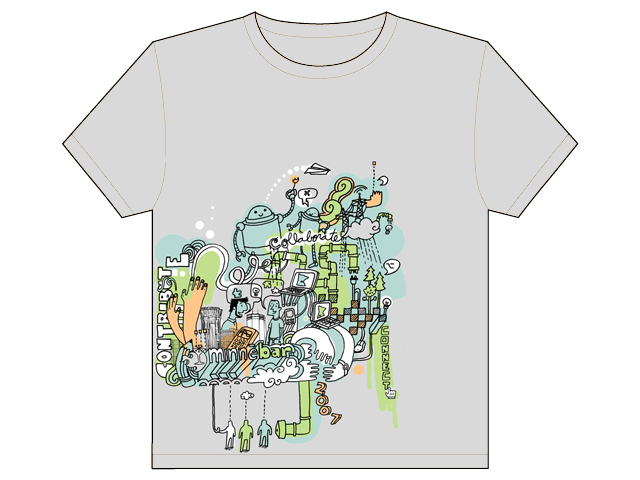
First, let’s start with my highlights. It was cool to meet Jay Goldman and David Crow. I virtually met Jay Goldman of Radiant Core a couple years ago by way of Geoff Norton > Mike Shaver. I noticed his name in IRC early into the conference and boy it’s a small world. Turns out he and David Crow, who claims to be a power bottom, were planning an event with Dan Grisby a guy I knew from when I helped Ben Edwards to organize a Bar Camp (MinneBar) in Minneapolis. Dan was the guy who branded all the Minnebar shirts with his name. How am I suppose to wear that? This year’s Minnebar tshirts kick ass and I’m hoping someone sends me one. I’ll plug the designer Bill Ferenc who I don’t think I know, but he deserves to be plugged because those shirts are very cool. Anyhow, strange how small the world is; especially in technology. I missed all of Thursday’s sessions. And I also missed the Make event, which I wish I could have made. So, the only other two highlights I want to point out are: 1). Amazon Web Services Party. This was held at some really funky bar and pizza joint called Basic. There were lots of tatoos, oil painters, chopped bicycles, gangster looking folks, a bunch of geeks, and Jeff Bezos. It was fun. I noticed Hober reviewed the place. 2). I thought Seth Raphael, MIT Media Lab, was really great. I enjoyed him and his session. He did some fun magic tricks for me in passing earlier than his session. I really enjoyed his connecting technology with magic. I never really thought about it. It also makes perfect sense that he’s studying the emotion of wonder. It’s been my experience we tend to lose this with age as well as our willingness to believe in the supernatural.

Now for some things that ETech can improve upon. Last year ETech was upstairs and I thought this was a lot better than where it was this year, downstairs of the Hyatt. I say this because this year there wasn’t a common area for folks to congregate as much as previously. Also, having sessions way out in different buildings kind of sucked. In general, stuff was just too spread out. Also, as previously mentioned, I could never find freakin’ coffee!! WTF! Every day I resorted to buying a cup of coffee from the bar at $4 a cup! That’s crazy. It would have been better if the Wifi reached the bar. And lastly, give us some chairs. Bring in the inflatable ones like you did in 2006 and you do at OSCON. Don’t get me wrong, I still love me some ETech.

I forgot to include one other highlight. The MindTouch Wii Scavenger hunt. The photos are hilarious. I should have had the participants post these to flickr though. Oh well, next time. Anyway, we’ll be doing these scavenger hunts regularly here in San Diego. Also, SteveB came up with a great idea of doing a WikiMe event. It will go something like this. We select a location, a block, a district, whatever. People come out and go mad in documenting the location for the San Diego wiki. Photos, bars, clubs, restaurants, history, whatever. We just go mad documenting it. MindTouch supplies beer and maybe tshirts or something. It will be a really cool way of developing an excellent online resource for San Diego. Also, for folks to meet one another. I’ll announce the first of these in the next week or so here and at OpenGarden.org.

Where are the chairs?

What is going on at this ETech? We’re in the Hyatt, but it’s downstairs this time. There is no shared space for people to mingle easily. There is a ton of traffic in the area from other conferences. And there are no chairs. Perhaps worse of all is the staff that is just blatantly snotty. Maybe they’re contractors and not O’Reilly staff. I’m not sure. The vibe is different from last year. Case in point: myself and another fellow walked up to a pair of chairs and asked a conference organizer if he minded if we sat in the chairs. His response was a terse: "actually I do mind".

There are dozens of us waiting for the keynote, which starts at 7:30PM (in 24 minutes) and they’ve barred us from the empty room the keynote is taking place. I feel like I’m back in high school and the O’Reilly staff (or contractors thereof) are the yard-nards with illogical rules about which side of the yard or parking lot you can be in. Maybe by tomorrow when the event is in full swing things will be a tad more friendly.

Kathy Sierra cancels at ETech07

Creating Passionate Users

As I type this, I am supposed to be in San Diego, delivering a workshop at the ETech conference. But I’m not. I’m at home, with the doors locked, terrified. For the last four weeks, I’ve been getting death threat comments on this blog. But that’s not what pushed me over the edge. What finally did it was some disturbing threats of violence and sex posted on two other blogs… blogs authored and/or owned by a group that includes prominent bloggers. People you’ve probably heard of. People like respected Cluetrain Manifesto co-author Chris Locke (aka Rageboy).

I am shocked and disgusted. Kathy Sierra has been receiving death threats for weeks and as a result has backed out of speaking at Etech! This is sick shit! This kind of behavior is disgusting. I sincerely hope these people are revealed and their mums give them a good thrashing. I cannot imagine this is anyone other than a twisted adolescent. Nonetheless I understand her concern. I caught Kathy’s session last year. It was one of my highlights at ETech06. She is brilliant. Best wishes K I hope this is quickly resolved.